Welcome to Canada
A powerful reminder of what freedom looks like through a child's eyes. When a young girl from a war-torn country is asked what she likes about her new home, her simple answer leaves an unforgettable mark on our founder's heart.
It is not unusual—in fact, it is more than likely—that we will see families from three different continents come through Safetynet on any given day. Each family brings with them unique life experiences, cultural traditions, religious beliefs, and personal histories.
What they share, however, is something much more powerful: hope. An optimism that the new country that has welcomed them will provide a fresh beginning—a sense of relief and opportunity after the challenges they have left behind in their homeland. I suppose it was the same for my family when they came to Canada from Ireland.
It is easy for me to get lost in the whirlwind of people coming and going — whether it is someone dropping off clothing, the phone ringing, a mother waiting to receive diapers for her impatient infant, or a family waiting to be checked out.
But every now and then, a family will pull me away from the daily chaos and the routine responses I often find myself giving while trying to stay focused on the task at hand. In those moments, I am reminded to slow down and truly see the people standing in front of me.
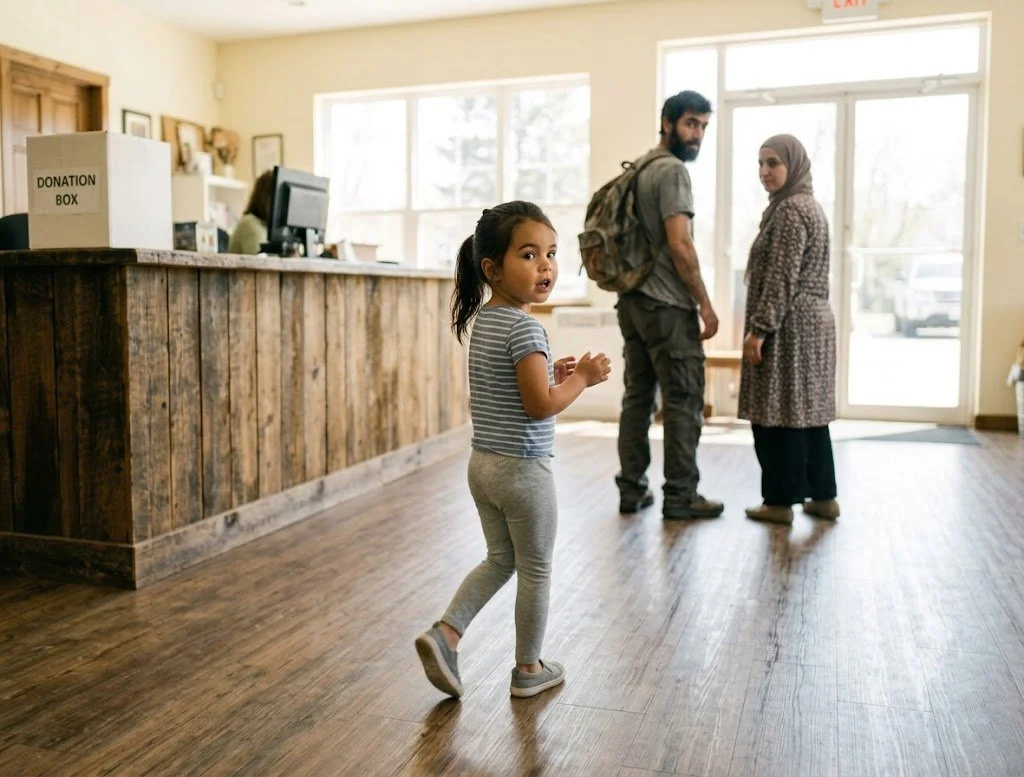
And so it was on this particular day that a family, while being checked out, caught my attention. They were from a part of the world that had been decimated by war and conflict — a country where its people were landlocked, trapped by circumstances beyond their control, and unable to simply leave. They were being assisted by one of our interpreters, who was engaging them in conversation.
There was a young girl in the family who was just tall enough for her chin to rise above our service desk. She was rubbing her chin along the wooden edge of the counter, seemingly unaware of the conversation taking place between her parents and the interpreter. Her eyes seemed fixed somewhere far away from where she stood. There was a familiar innocence in her expression — the kind of innocence children carry. Yet, I could sense that this innocence had already been shaped by experiences that no child should have to endure. Had she remained in her homeland much longer, that innocence may have been taken from her.
I said hello to her, and she answered back in English.
“Hi!”
She spoke English.
“How do you like Canada?” I asked.
“I like Canada!” she responded.
Now, I have been particularly frustrated by the cool, grey spring we have been having. Caught up in my own small frustrations, I said to the girl as her family was making their way toward the door:
“Don’t you find it cold here?”
She turned and replied, “A little bit.”
I then asked, raising my voice slightly to reach her as she moved farther away:
“Well, what do you like about Canada?”
She stopped, turned around, and looked back at me.
“Here we are free… We are safe.”
Now, I do love my country, but I have never considered myself overly patriotic. I have always struggled to understand those who become consumed by displays of patriotism. To me, chanting your country’s name at sporting events or watching military jets fly over stadiums can sometimes feel like an extension of an inflated national pride, and history has shown that this does not always lead to positive outcomes.
But standing there in that moment, listening to a young girl who had come from a place of fear and uncertainty, I saw Canada through a different lens. For her, Canada was not about flags, ceremonies, or displays of pride.
Canada was freedom.
Canada was safety.
And sometimes, it takes the perspective of someone who has lost those things to remind us how much they truly matter.
I felt an emotional lump rise in my throat. Like the Grinch in his moment of revelation about Christmas, I suddenly understood something about Canada that I had always known, but perhaps had never truly felt.
I looked at her and, barely able to get the words out, I said:
“Welcome to Canada.”
And to my country — a place that, at its best, represents freedom, understanding, and compassion —
Happy Birthday.
A Community Coming Together: The Learning Grove's Spring Donation Drive
Sometimes the most meaningful moments happen when people decide to show up for others.
This spring, The Learning Grove — an organization dedicated to empowering individuals with disabilities to build independence, social skills, and community connections — reached out to Safetynet with something special: the individuals they support had organized a spring donation drive to collect items for Safetynet families in need.
It wasn’t just a collection of goods. It was a project. From planning and sorting donations to connecting with community partners, the individuals at The Learning Grove were involved at every step — building teamwork, communication, and leadership skills along the way. For many, it was a chance to see their own capacity to make a difference.
That’s exactly the kind of ripple effect community support creates. Families in Halton and Peel receive what they need. And the people doing the giving discover something about themselves in the process.
The Learning Grove is a part of Safe Management Group, a Canadian leader in crisis intervention and prevention training, sharing a commitment to safe, supportive environments for both individuals and the staff who serve them.
We are so grateful to The Learning Grove, their team, and every individual who participated. This is community at its best — people lifting people.
Want to host a donation drive for Safetynet?
Visit safetynetservices.ca or email info@safetynetservices.ca to get started.
The System
The morning started off as a typical day at Safetynet. I battled the traffic and the pop-up road construction that always seems to accompany the first warm days of spring, arriving at the charity around 8:30 a.m. Mark was scurrying around the building packaging diapers, constantly changing direction whenever another task popped into his head.
I was sitting at my computer when I noticed a woman hunched over in the women’s section of the clothing bank. Safetynet doesn’t open until 9:30, but some of the homeless clients arrive early because they prefer to remain unnoticed.
A few moments later, the woman approached the checkout counter, and one of our students hurried over to help her. We gave her a gift card for Tim’s, which made her smile. I looked at her closely. Her face was sunburnt, her hands were muddied, yet she managed to maintain her pressed-on nails. I tried to guess her age, but with people living on the streets, it’s difficult. Exposure to the elements ages faces long before their time.
She looked deeply sad and kept her eyes fixed on the ground as she was being checked out.
“You okay?” I asked.
“No,” she quietly responded.
“What’s going on?” I persisted.
“I’ve been sleeping at the GO station, but the police kicked me out. I have nowhere to go…”
I told her I would try to find a bed for her. She looked at me with a brief flicker of optimism, quickly followed by resignation.
After 35 years in social services, there are still days when I’m amazed by how naïve I can be.
I immediately started calling shelters in the area — though in Oakville, there are very few. The first shelter didn’t answer, so I looked them up online only to discover they housed men only.
I moved on to the next shelter, where I was informed they only accepted clients brought in by police. Given her experience at the GO station the night before, that was clearly not an option.
I contacted another shelter, only to be told she had to be a Halton resident and provide proof of residency.
I told them, “She’s homeless. She has no residence.”
“I’m sorry,” they replied, “she has to return to the last city where she resided.”
My frustration must have been palpable. She looked at me with a knowing smile and said, “This is our experience every day.”
Still clinging to my naïveté, I told her I would try one more place. She gave me the same half-smile and said she was going out for a smoke while I made the call.
The final shelter gave me a list of requirements she would need to meet before qualifying for a bed.
I hurried back out to the parking lot, but she was gone.
She had disappeared into the day and never returned.
I had the luxury of frustration.
She carried the burden of hopelessness.
The Cycle Bill Shields Set Out to Break
Safetynet exists because of Bill Shields. He started it in 2006, and twenty years later it has supported close to 10,000 families. But what it does every day — and what it is ultimately trying to fix — comes straight from the person who built it. Bill grew up in Willowdale in the late 1960s, raised by a single mother. He understood early what it feels like to go without, and to be on the outside of things other people take for granted. That stayed with him, and it shaped the work he chose.
He spent three decades in social services before Safetynet existed — working with children with developmental differences at the Salvation Army, then with agencies serving people experiencing homelessness, then nine years at the Children’s Aid Society in Toronto, including running a group home of his own. It was a long stretch of meeting families at their hardest moments, and of watching the same hardship repeat from one generation to the next.
In 2003, Bill and his wife Rhonda moved to Oakville. It’s a prosperous community, which can make the people struggling within it easy to miss. Bill noticed anyway. He could see the need was real, just quieter than what he’d known in Toronto, and he wanted to do something about it directly.
In 2006, that became Safetynet — at first just Bill, part-time, handing out clothing to people struggling financially in a local neighborhood. Building it was hard, and raising the money to keep it running was the hardest part of all. Funders wanted a track record he didn’t yet have. One company backed the work without being asked: Geotab, who has remained a significant supporter ever since. In those early days, that support mattered as much for the confidence it gave Bill as for the funding itself.
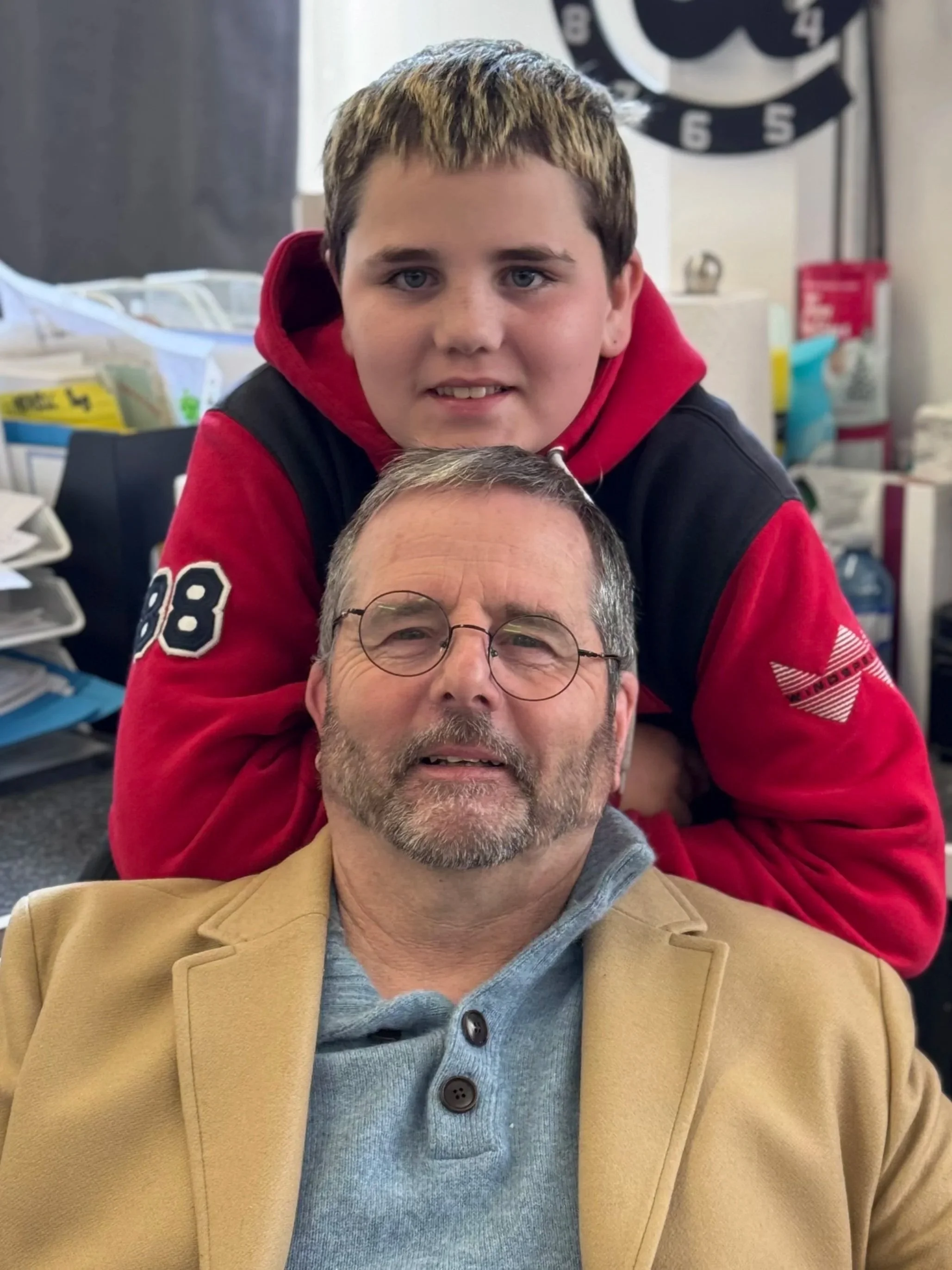
Bill and his son Billy
What Bill set out to do was never just hand out clothes.
The clothing, housewares, furniture, diapers, and other free essentials are there to lift families out of immediate crisis — the constant scramble that leaves no room to think past the week. But getting out of crisis isn’t the same as escaping poverty for good. In the time Bill spent working in the field of social services he observed that poverty is generational and that families he worked with lacked an education.
That’s why Safetynet also offers free weekly tutoring. The tutoring matters most to Bill. A child who keeps up in school has a genuinely different future than one who falls behind — and for Bill, helping a child succeed in their education is what changes a family’s path for good and breaks the cycle of poverty.
Bill also felt that money should not be a barrier to a child who has an aptitude or interest in music. Growing up with music played an important part in Bill's life, so the music program was started to support children who had an interest in music, but whose parents could not financially support the lessons.
Recognition came along the way. The three Oakville Rotary Clubs jointly presented Bill with the Paul Harris Fellowship Award in late 2017, and in 2022 he received the Queen’s Platinum Jubilee Pin for outstanding service. Neither changed how he works.
Bill still lives in Oakville with Rhonda. He has four children and is pictured here with his youngest, Billy. Twenty years on, he is still at it — driven by the same goal he began with: to help as many people as possible, and to give children a real shot at a different future. Find out how you can be part of this incredible journey.
Two Decades of Showing Up: Safetynet Turns 20
Twenty years ago, Bill Shields started handing out clothes to neighbours in need. Part-time. Out of conviction. No warehouse, no staff, no plan to build something that would last two decades — just a refusal to walk past people who were struggling when he knew he could do something about it.
That's where Safetynet starts. Not with a mission statement or a strategic plan, but with one person who decided that doing nothing wasn't an option.
There's more about Bill's story here — the career that led him here, what set him on this path, the recognitions he'd never bring up himself. What none of it quite captures is what twenty years of showing up looks like.
Twenty years of opening the doors. Twenty years of sorting donations and getting them into the hands of families who needed them. Twenty years of the same quiet conviction: poverty is a cycle, and a cycle can be broken.
There is no Safetynet without him. We say that plainly, because it's true.
Almost 10,000 families
This is the number that stops us when we sit with it.
Safetynet is approaching 10,000 registered families. Ten thousand households that, at some point over the last twenty years, came through our doors and found something they needed — a winter coat, a dining table, a pack of diapers — at a moment they couldn't afford to buy it themselves.
Behind each of those families is a story we don't always get to hear. A parent who'd been quietly going without so the kids didn't. A newcomer family setting up a home from scratch. A grandmother raising grandchildren on a fixed income. A mom leaving a difficult situation with only what she could carry.
The number is big. What it really represents is one moment of relief, almost ten thousand times over.
What a typical month looks like now
We've grown into 5,000 square feet. In a normal month, Safetynet now gives out:
• 4,500 pieces of gently-used clothing
• 1,000 houseware items
• 225 pieces of furniture
• 12,000 diapers
Every one of those numbers is someone's morning made easier. A child heading to school in a coat that fits. A family eating dinner together at a table for the first time in months. A parent who didn't have to choose between diapers and groceries this week.
Nothing wasted
From the beginning, Bill built Safetynet on the idea that nothing should go to waste. Every year, we responsibly recycle 400 tonnes of material that would otherwise end up in landfill. Clothing too worn or stained to pass on to our clients gets recycled too. Nothing is thrown away.
Independent from day one
Another thing Bill has held to from the start: Safetynet would be self-funded. Not government-funded. He wanted the charity to answer to the community it serves, not to a funding formula — and to be free to run lean, move quickly, and adapt to what families actually need.
Twenty years on, that vision has held. Safetynet runs on the generosity of individuals and businesses across our community. Every dollar that comes in is a dollar someone chose to give.
Breaking the cycle
Clothing and furniture solve today's problem. Ending the cycle of poverty — Bill's north star from day one — takes more than that.
That's why Safetynet also offers free weekly one-on-one tutoring and free weekly music lessons for children in our community. These aren't extras. They're some of the most important work we do. Tutoring helps kids stay on track at school when home life is stretched thin. Music lessons give them something that's theirs — a discipline, a joy, a sense of capability — that no one can take away. Both are offered at no cost. Both, over time, change the trajectory.
Twenty years in
We don't quite know how to mark 20 years except by saying thank you, and by doing it again next year. There will be a proper way to celebrate this milestone together later in the year — more on that to come.
Thank you to the donors who keep us going — with money, with new toiletries, with bags of gently-used clothing dropped off at the door. Thank you to the volunteers who sort, lift, fold, drive, teach, and tutor. Thank you to our staff — the people who take inventory, welcome clients through the door, listen, help families find what they need, deliver furniture across the region, and quietly hold the whole operation together day after day. Thank you to the businesses and community partners who've stood with us — some, like Geotab, for nearly all twenty of those years. Thank you to the families who have trusted us, sometimes on the hardest day of their year.
And thank you, Bill — for the unglamorous, unwavering, twenty-year version of showing up. None of this exists without you.
Here's to the next chapter.
Sophia’s Kindness Club: One 10-year-old Making a Difference
Sophia Khalid is 10 years old. Over the past year, she’s been fundraising, collecting donations, and buying supplies for Safetynet families — on her own initiative, with her own money.
She calls it Sophia’s Kindness Club.
It started because Sophia felt bad for families who had less. So, she did something about it. She set up a lemonade stand. She took on babysitting jobs. She talked to her friends, who showed up with bags of gently-used clothing for Safetynet clients. She used the money she raised to purchase supplies that families need.
For her 10th birthday, she asked for donations instead of gifts.
Her efforts have been recognized by her Member of Parliament, the Prime Minister of Canada, and Stephen Crawford. But ask Sophia why she does it, and the answer is simple: it makes her happy to know she’s making a difference.
That’s exactly the kind of community we’re proud to be part of.
Do you have a story you’d like to share? We’d love to hear it. Reach out to us at karen@safetynetservices.ca.
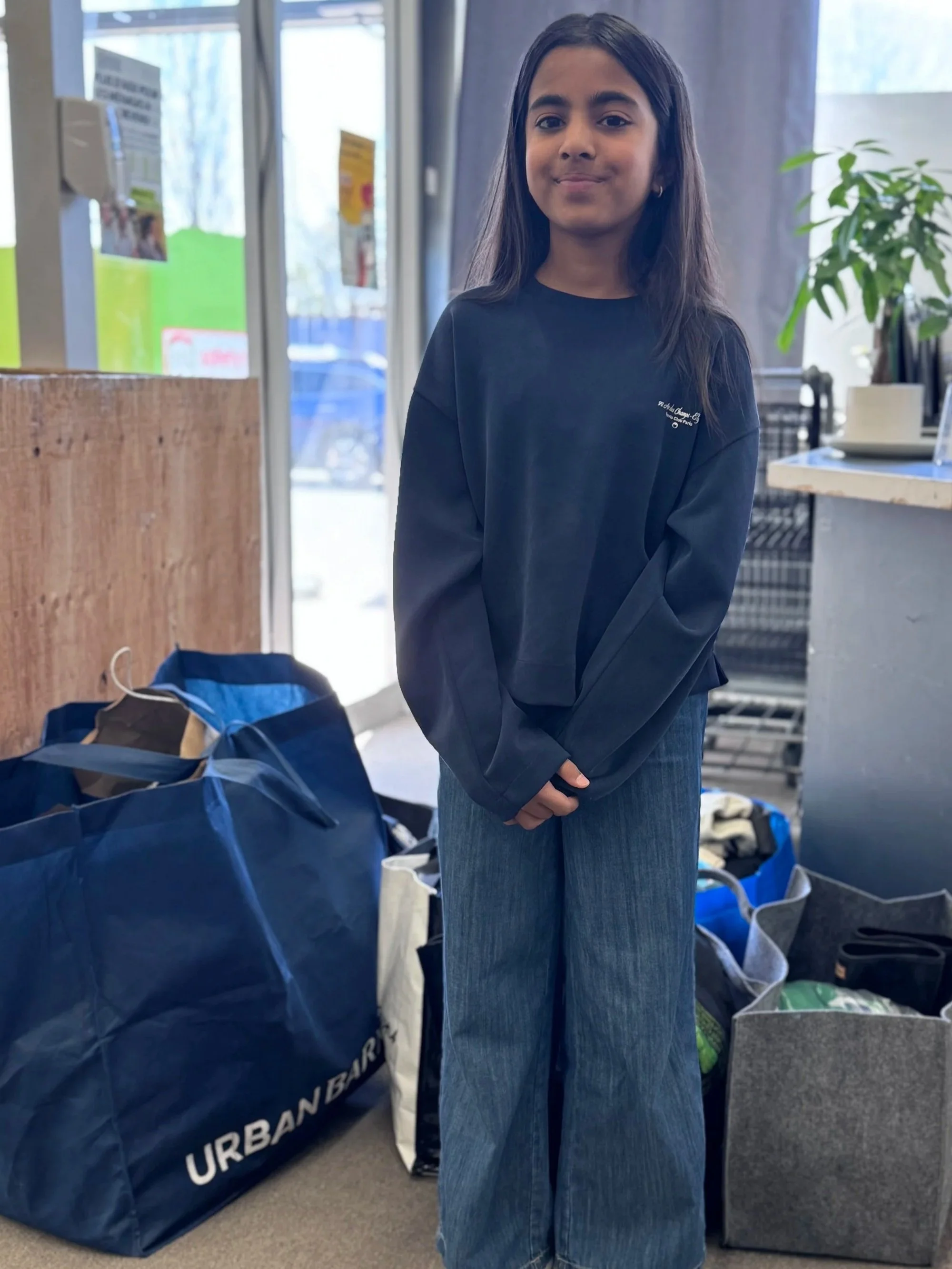
Sophia Khalid, Creator of Sophia’s Kindness Club
Don't Throw It Out — Families Need It
Spring cleaning. A move. A basement that got out of control. Whatever the reason, most of us have things we no longer need — and most of us aren't sure what to do with them.
Before you book a junk removal truck, consider this: what you no longer want might be exactly what a family in Halton or Peel needs right now.
At Safetynet Children & Youth Charities, based at 166 South Service Rd East in Oakville, we accept a wide range of donated items and put them directly into the hands of families experiencing financial hardship — free of charge.
Here's what we need, and how to donate.
Clothing, Footwear and Accessories
Our clothing bank accommodates 5,000 appointments every year. We accept gently used clothing and footwear for men, women, children and babies — spring, summer, fall and winter — as well as purses and belts.
When you're sorting before you donate, please separate items into two bags:
Good condition — gently used, clean, wearable
Recycle — stained, torn or well-worn items, labelled RECYCLE
Please don't throw out worn or damaged items — we recycle tonnes of material every year and receive funds by the pound. Your worn-out clothes directly fund our programs, keeping them out of landfill and putting money back into services for families.
Donations can be dropped off at the charity during open hours, or left in the bins out front after hours.
Furniture
We accept gently used furniture — sofas, tables, chairs, dressers and more. Please note we do not accept used mattresses.
For furniture donations, email furniture@safetynetservices.ca with this information to arrange for a pick up.
Housewares and Kitchen Items
We accept gently used kitchen supplies and small appliances, including:
Sets of dishes, glasses and mugs
Sets of cutlery
Pots, pans and cooking implements
Kettles, blenders and toasters
If you're upgrading your kitchen, these items are always in demand.
Linens, Towels and Blankets
Gently used bed sheet sets, towels and blankets are always welcome. These are everyday essentials that families often can't afford to replace.
Toys, Books and Home Décor
These items aren't essentials we keep on hand, but they don't have to go to waste. We have a partnership with Talize, who accepts these items and pays us by the pound — keeping usable items out of landfill while directly funding the charity.
New Items Always Needed
If you'd like to purchase something to donate, the items most consistently needed are:
New socks (all ages)
New underwear (men's and women's, size Medium most needed)
Diapers
Deodorant
Feminine hygiene products and personal care essentials
These are everyday items that can put a real strain on a family's budget.
How to Donate
Drop off: 166 South Service Rd East, Oakville — visit safetynetservices.ca for current hours. After-hours bins are available out front for clothing donations.
Furniture: Email furniture@safetynetservices.ca
Online donation: Visit safetynetservices.ca to donate by eTransfer or credit card.
Why It Matters
We've served nearly 10,000 families across Halton and Peel over 20 years. Every clothing item, every pot, every bag of socks makes a real difference to a family starting over or simply trying to get through the month.
This year, we're celebrating our 20th anniversary — two decades of community generosity turned into real support for real families right here in our community.
If you have something to give, there's a family that needs it.
Safetynet Children & Youth Charities | 166 South Service Rd East, Oakville | safetynetservices.ca